Want to increase the course value for your online program?
BONUSES are an easy way to do this.
However
While every online course has them… most fail to live up to the hype.
You see
Bonuses are not ✨ glitter-wrapped rocks.
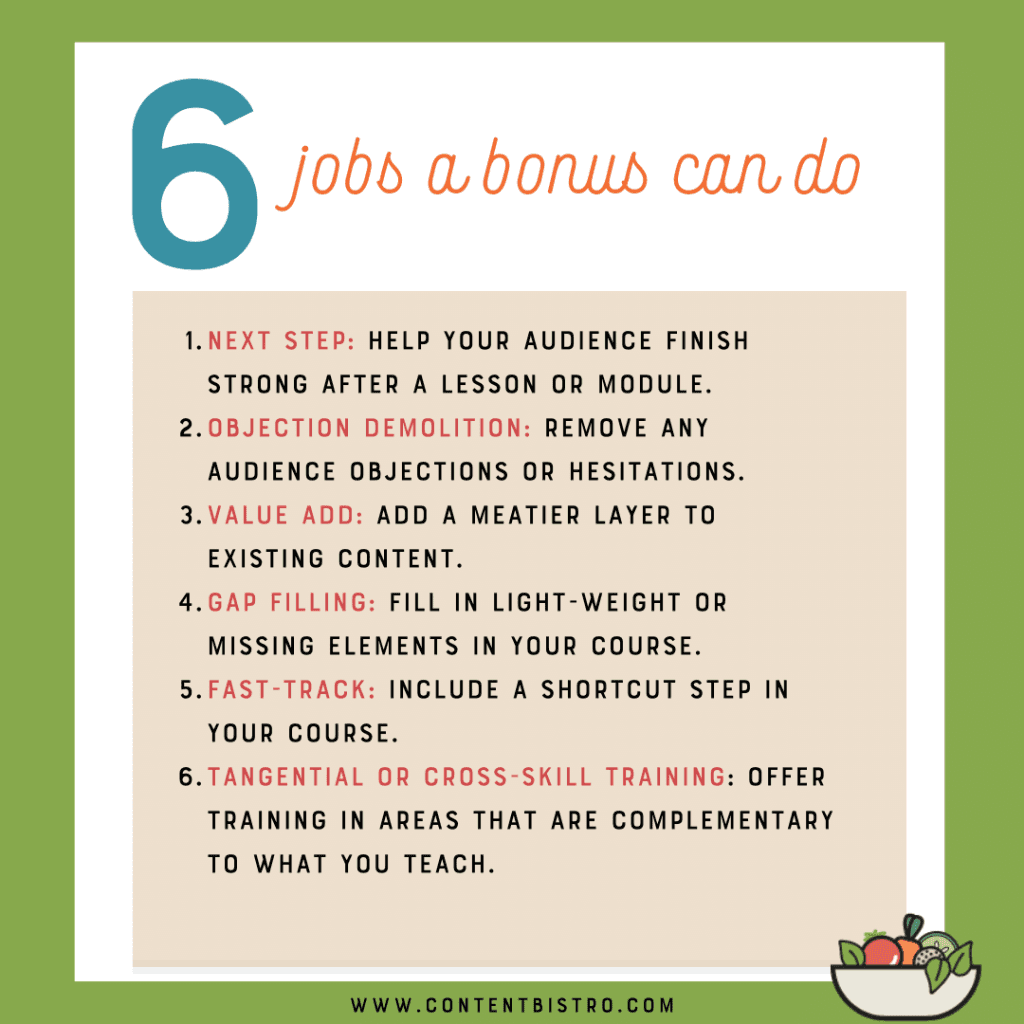
Your online course bonuses have a JOB to do. In fact, they could do any one of 6 jobs.
Let me explain.
A bonus isn’t something you add to inflate the value of a course so you can slap on a random $$ number and claim that the value is 10xed magically.

A bonusisn’ta last-minute thought or a lint-covered “training” you’d recorded many moons ago.
A bonus is meant to be meaningful and intentional in order to have real, tangible value for your audience.
How Do You Identify Tangible Course Value for your Bonuses?
When deciding on your bonuses, this is the ONE question you need a clear answer to.
What is the JOB this bonus will do for my audience or offer?
Uncovering answers to THIS question is a huge part of what we do in our offer optimization sessions.
To help you answer the question, here are SIX jobs a bonus can do:
✅ Next Step: These bonuses are designed to help your audience take that all-important next step after finishing a particular module or lesson.
For instance, in Ready-to-Sell, we have next-step bonuses at the end of every module.
✅ Objection Demolition: The job of this bonus is to remove any objections your audience may have. Let’s say, you know time to complete the course is a legit objection. How about you include a bonus training from a time management expert to help your audience carve time out even when none exists?
✅ Value Add: You hire this bonus to add value to your existing content. This is a cool-to-have training bonus. It may not be the next step, but it makes the main dish (aka module) that you’re teaching meatier.
✅ Gap Filling: This is a great job for a bonus. If you have a program that you notice is missing certain elements, you can always add a bonus to fill the gap instead of re-recording the whole shebang.
✅ Fast-Track: When you include a fast-track bonus, it is a shortcut to the shortcut. That’s right. Your course is a shortcut for students. Your fast-track bonus is a shortcut to a step in your course.
Fast-track bonuses are great to include but exercise caution when offering them. A lot of students may take the fast track and skip crucial steps. You can choose to offer these selectively to more advanced students. Or include the caveat about who these are perfect for.
✅ Tangential or Cross-Skill Training Bonuses: These bonuses offer training in areas that are complementary or tangential to what you teach.
For instance, our brilliant client and epic eCommerce copywriter, Samar Owais, includes bonus trainings by guest experts on cold pitching, content repurposing, and more in her eCommerce Email Bootcamp program.
How do You Increase Course Value and Offer These Bonuses?
Glad you asked.
Here are THREE different ways to offer a bonus so you create urgency and desire while also giving tangible value to your audience:
Module-specific Bonuses: This is what we offer (and teach!) in Ready-to-Sell. A module-specific bonus is one that builds on a module and helps your students take the next baby step, specific to that module. For instance, in our module on Opt-in Pages, one of the bonuses is my Non-Webinar Webinar Outline while another is 35 Opt-in Ideas.
Launch-Only Bonuses: These are excellent if you’re using LIVE launches as your sales mechanism. Heather Eland of Astrology with Heather did this recently when she offered robust, well-designed workbooks for the live launch of her flagship program.
Completion Bonus: Another strategy that we’ve used and recommended to clients is the completion bonus.
Next-step bonuses and cross-skill training bonuses lend themselves beautifully to this bonus style. You unlock this bonus after your students have completed a module or the course itself.
Ready-to-Sell has a cool Completion Bonus – Create Your Own Always-Ready-to-Sell System

You’ll notice I haven’t mentioned the usual “fast action bonus” or “mid-cart bonus” and it’s not that they aren’t effective or don’t work, it’s just that Mayank and I believe in NOT penalizing customers who like to take time to make a decision.
So, while we do have clients who offer these, we personally don’t endorse fast action bonuses or mid cart bonuses.
Well, now that you know how to choose a bonus and when to offer it, let’s talk about…
What to Actually Offer as a Bonus to Actually Increase Online Course Value
Just like an opt-in or course-specific content invite, you don’t have to always toe the trend when it comes to bonuses.
Here are 25 different ideas, complete with examples, to offer as a bonus depending on what job it’ll do. 👏🏼
⭐ Idea Number 1: Ebook 📓
An ebook bonus is an excellent way to establish your expertise and authority with your ideal client. A well-crafted ebook covering complex material positions you as a trusted resource and subject-matter expert. Not only does this help boost your credibility, but it can also help qualify and segment high-intent VIP clients and leads. PLUS… it’s not always the case, but people interested in downloading long-form white papers and ebooks are usually high-intent/most-aware prospects.
For example:
Let’s say your audience wants to learn how they can strategically use systems to scale their business and get time back in their schedule, right? Your ebook bonus wouldn’t be a quick primer on systems and productivity.
Your ebook might have:
A thorough overview of system stacks and a how-to of each one.
Featured no-so common issues but critical things you should look out for.
A methodical walk-through of how systems need to align with your SOPs
An SOP best practices & audit prompt.
A team training primer and when it’s best to seek white-glove assistance to get you up and running.
Relatable case studies or examples of different ways people can use systems to help their business.
⭐ Idea Number 2: Companion Course 🧑🤝🧑
A companion course bonus can help skyrocket an online course’s value. This is “recommended additional learning material” you stack and offer before, during, or after your main offer.
It should complement the main offer with other learnings, resources, worksheets, and content, allowing you to go deeper into a subject area OR explore related areas and relevant topics.
For example:
A Graphic Designer who teaches non-designers (those who only have experience with drag and drop programs like Canva) how to use InDesign with an “essentials only” companion course which would be beginner-friendly.
The core objective is to get students comfortable in the InDesign space (with plenty of practice files and templates).
In this way, positioning a companion course as a primer can help shorten the learning curve (so they aren’t stuck in Module 1 weeks into the main course) and increase course completion.
⭐ Idea Number 3: Quick Wins Checklist ✔️
Your Quick Wins checklist acts as a top-level walk-through to guide your audience to reach a specific goal or create a specific (and achievable) deliverable.
It’s a simple step-by-step framework that provides an outline or roadmap to follow. And people succeed in reaching project completion with confidence and the certainty that they didn’t miss any important steps on the way.
For example:
If you help female founders find their authentic brand voice, you could use a Quick Wins checklist to act as a guide to creating a more value-aligned positioning statement.
Your quick list checklist could methodically outline the steps to achieve a more authentic elevator pitch. Your checklist could include:
Select pieces of content that best reflect their personality.
Highlight their power words.
Prompts about their origin story.
Prompts for their “WHY” motivations.
A competitive USP assessment.
Establishing core terms and values.
And then, bring it all together using your framework to assemble their brand story arc that translates into a clearer brand
⭐ Idea Number 4: Plug-and-play templates 🔌📋
These are one of the most common types of content-based bonuses; usually positioned as an out-of-the-box easy solution for a specific problem. Templates should be intuitive and straightforward; requiring little to no additional how-to instruction. This should be reliable and easy to use for a specific deliverable or content asset.
For example:
If you’re an OBM, you could package & share the templates and canned emails you use for following up with clients and leads. You can have one set OR bundle several types of templates together. You could include:
Your initial welcome message for new clients.
Your project status email updates.
Your go-to canned out-of-office responses or housekeeping notices.
Your follow-up for warm leads that have gone cold.
Your template for “tricky” client emails: scheduling issue, feedback required, payment overdue.
Remember delivery should be uncomplicated, like a shared Google Doc or PDF that’s rights protected (so they don’t overwrite your file).
⭐ Idea Number 5: Work-it out Workbooks 🏋🏽
A good, old-fashioned set of workbooks is the old-school mainstay of bonuses.
They are versatile and self-guided. A workbook requires the user’s own feedback often through exploration.
They often act as a “container” of collected learnings and insights. Workbooks can be stand-alone as a self-directed “ bonus workshop” or paired in tandem with a course or program.
For example:
Workbooks, quite often, are useful as a functional tool as well as a space that records your client’s reflections.
Let’s say, you’re a lifestyle nutritionist who serves former die-hard meat-eaters (newly turned vegetarian) who have NO idea how to cook vegetarian meals beyond pasta.
Your workbook could act like a 3-week transitional aid; helping people learn how to cook high-protein, iron-rich vegetarian meals. Your workbook would essentially serve as a record-keeping device. You could include:
A series of sample menus that they can use to mix and match their own weekly meal plan.
A protein tracker.
Prompts for reflection (how they feel after eating a full vegetarian meal – still hungry, satisfied, overly-full?)
Even an interactive “calculator” – to make sure they aren’t filling up on refined carbs to feel filled up.
Spaces for them to collect wins and meal prep best practices.
⭐ Idea Number 6: Fast Learning Flashcards ⚡🃏
It’s like school all over again!
Flashcards as bonuses for online courses help with memory and subject retention. A well-designed deck of flashcards can accelerate the learning curve.
Ideally, a flashcard deck should be highly visual to represent key terms, definitions, and ideas so you can refer to them for a quick and accessible way to cement your learnings.
For example:
Used frequently in licensed industries that require testing to acquire a professional title or designation (legal, real estate, and even PMP fields), it can also be used in a variety of fields to gain deeper knowledge, explore a new topic area or help with creative flow and brainstorming.
If you are a print designer pivoting into UX design, it might be helpful to have a flashcard deck with common UX, CRO, and usability terms, so that you can broaden your general knowledge bank, grasp the lingo, and understand the issues web development teams face.
⭐ Idea Number 7: Audit or Critique 🧠 📑
An audit or critique bonus means you are offering to share your time, expertise and feedback – usually (but not limited to) for a content asset and deliverables.
The parameters of an audit should be clearly defined (like a 1:1 call w/ feedback) so people can manage their expectations of how this audit or critique will help them. AND then they can appreciate its full value.
For example:
If you’re a seasoned launch copywriter, you can provide them with critical feedback on their new offer for their upcoming launch or up the ante and combine a critique of their sales page messaging with an audit of their offer. You could:
Do a copy critique of their services page.
Provide a messaging audit of their top competitors to look for a positioning gap so your clients can be more strategic with their USP.
OR – you could offer a thorough audit of their services and help them craft a more compelling and irresistible offer for their target audience.
Want critiques from me for your copy? Jump on the Ready-to-Sell waitlist because complete copy critiques are a much-loved bonus in there!

Newsletter
Join founders and operators building calmer, more profitable sales systems
No spam. Just smart strategy that works.